Overview
What ZMINE is, in one page.
ZMINE issues a fixed supply of 210.00M MINE through time-based mining on top of Zcash. Every 10 minutes an epoch pays a fixed reward, split among accounts in proportion to their hashpower. Hashpower comes from a free daily session, staked ZEC, boost packs, Genesis passes, intelligence tasks and referrals. MINE trades against ZEC on a built-in order book. ZEC moves on the Zcash network and can arrive from other chains through the wallet's bridge; MINE lives in an audited ledger until it issues as a Zcash Shielded Asset after NU7.

Numbers that never change
- Total supply
- 210.00M MINE
- Pre-allocated
- 0
- Epoch
- 10 minutes
- Month 1 reward
- 24,305.5555 MINE per epoch
- Halving
- every 4,320 epochs, which is 30 days
- Stake rate
- 100.00 H per ZEC
- Free pool
- 1.00 kH shared, max 25% of an epoch
- Genesis passes
- 3,000 ever, 30.00 H each, permanent
- Referral commission
- 5%
Where to read next
Mining explains sessions, the free pool and the live counter. Hashpower and boosts has the pack ladder and the Genesis Pass. Wallet covers deposits, withdrawals, staking and the bridge. Security states exactly what is protected and what is not.
Account
A login key and a recovery phrase. No email, no password.
Creating an account takes one tap and returns two secrets: a login key and a 24-word recovery phrase. Only one-way hashes of both are stored, so nobody can read or reset them. The login key signs you in; the phrase reissues a lost login key and signs out every device. Each account also gets a shielded (unified) and a transparent Zcash deposit address.

Two-factor
Enable an authenticator app in Settings. From then on withdrawals, adding withdrawal addresses, key rotation and auto-pilot spending all require a code, and sign-in asks for it after the login key.
Devices
Settings lists every signed-in device with its first-seen time. Revoke any of them, or all but the current one, in one click.
Mining
Epochs, sessions, the free pool and what the live counter means.
Epochs
Time is divided into 10-minute epochs from genesis. At the end of each epoch the worker snapshots every account's hashpower at that exact instant, sums the network and pays the epoch reward pro rata. Settlement is one database transaction per epoch and happens exactly once, so a restart never double pays.

The free session
One tap starts a 24-hour session. Sessions draw from a shared free pool of 1.00 kH: the pool is divided among everyone with a live session, with a cap of 25.00 H and a floor of 1.00 H per session. Fewer miners, bigger share. Renewing inside the last 30 minutes keeps the streak, which multiplies everything session-gated by 2% per consecutive day, up to +20%.
| Active sessions | Each gets | Total free hashpower |
|---|---|---|
| 1 to 40 | 25 H | 25 to 1,000 H |
| 100 | 10 H | 1,000 H |
| 250 | 4 H | 1,000 H |
| 1,000 | 1 H | 1,000 H |
| 5,000 | 1 H (floor) | 5,000 H |
The free share is capped
Session, referral and task hashpower together can take at most 25% of any epoch. Whatever they would have earned above that goes to ZEC-backed hashpower (stake and packs) pro rata; if nobody has ZEC behind their hashpower, that part stays in the pool. With 1,000 free accounts and one staked ZEC, the staker earns 75% of every epoch. Under the cap, settlement is plain pro rata.
The live counter
The Mine page shows MINE accruing every second. It is your projected share of the current epoch, pro rata to the time elapsed, computed from the network as it stands right now. The number becomes a real ledger entry when the epoch settles; if the network changes before then, the final amount differs by the same proportion.
Idle accounts earn nothing
An account with no session, no stake, no pack and no task credit has zero hashpower and is simply not in the snapshot. There is no passive drip.
Hashpower and boosts
Every source of hashpower and the boost pack ladder, with the math.
Hashpower is an integer that only exists to divide each epoch's reward. It is not proof of work. Six sources add up, and a streak multiplier applies while a session runs.

- Free pool
- 1.00 kH / active sessions, 1.00 H to 25.00 H
- Staked ZEC
- 100.00 H per ZEC, around the clock
- Referrals
- 2.00 H per active referral, max 25
- Task credits
- 5.00 H per correct answer, 24 h, 12 a day
- Genesis Pass
- 30.00 H per pass, permanent, 3,000 ever
- Streak
- +2% per day, max +20%
Genesis Pass
A numbered pass minted on the Mint page for $2 of ZEC at the moment of minting; the ZEC goes to the treasury. Each pass adds 30.00 H to your rig from the next epoch, with or without a session, forever. Exactly 3,000 will ever exist and one account may hold any number. Pass hashpower is ZEC-backed, so it is never clipped by the free-share cap. Passes cannot be transferred or refunded today; when MINE issues as a Zcash Shielded Asset the passes are planned to issue alongside it.
Boost packs
A pack is ZEC spent for time-limited hashpower; it goes to the treasury, not to other miners. Packs are priced per hashpower-day with a volume discount. The reference is staking: 1 ZEC staked is 100.00 H forever with the ZEC still yours, which is 3,000 H-days a month.
| Pack | Hashpower | Lasts | Price | H-days | H-days per ZEC |
|---|---|---|---|---|---|
| Spark | 8.00 H | 24 h | 0.001 ZEC | 8 | 8,000 |
| Pulse | 25.00 H | 2 days | 0.005 ZEC | 50 | 10,000 |
| Surge | 300.00 H | 5 days | 0.1 ZEC | 1,500 | 15,000 |
| Forge | 1.00 kH | 10 days | 0.5 ZEC | 10,000 | 20,000 |
| Titan | 1.60 kH | 15 days | 1 ZEC | 24,000 | 24,000 |
| Apex | 7.00 kH | 30 days | 7 ZEC | 210,000 | 30,000 |
Whether a pack is worth it
Every pack card shows two live numbers. Expected MINE is the pack's share of the reward at today's network, over its whole life, with the pack itself added to the network (so it never overstates). Break-even is the pack price divided by that expectation: the MINE price above which the pack pays for itself. As more hashpower joins, every pack's expectation falls, which is what keeps pack returns from running away.
Tokenomics
Supply, emission by era, and where fees go.
210.00M MINE exist. All of it sits in the mining pool at genesis and leaves only through epoch rewards. The reward halves every 4,320 epochs, which is 30 days. The first month releases half the supply, the first three months release seven eighths, and the first year releases 99.98%. What remains after that keeps halving into ever smaller amounts rather than stopping outright, so mining is a one year event in every way that matters.

| Era | Starts | Per epoch | Era total | Cumulative |
|---|---|---|---|---|
| 1 | Oct 2026 | 24,305.5555 MINE | 105.00M MINE | 105.00M MINE |
| 2 | Nov 2026 | 12,152.7777 MINE | 52.50M MINE | 157.50M MINE |
| 3 | Dec 2026 | 6,076.3888 MINE | 26.25M MINE | 183.75M MINE |
| 4 | Jan 2027 | 3,038.1944 MINE | 13.12M MINE | 196.87M MINE |
| 5 | Feb 2027 | 1,519.0972 MINE | 6.56M MINE | 203.44M MINE |
| 6 | Mar 2027 | 759.5486 MINE | 3.28M MINE | 206.72M MINE |
Where ZEC goes
- Staked ZEC
- stays yours, held in the public staking reserve, unstake with a 24 h cooldown
- Boost packs
- treasury
- Genesis passes
- treasury
- Trading fees
- taker 0.2%, maker 0, to the fee account
- Withdrawal fee
- flat, to the fee account; the network fee the wallet actually pays is carried by the treasury
- Bridge
- the provider's rate includes its fees; ZMINE adds nothing
- Referral commission
- 5% of referees' rewards, paid from the pool on top
Why one year
A schedule stretched over decades pays almost nothing per day and gives nobody a reason to arrive early. Compressed into a year, the first month alone carries half of everything that will ever exist. Whoever mines in month one is competing for a far larger prize than whoever mines in month six, and the arithmetic says so rather than the marketing.
Market opening
The order book can open a few days after mining starts. Early sellers then hold days of rewards rather than one epoch, and buyers see a book with depth instead of an empty one. The Market page shows the opening instant once it is announced, and a plain "soon" until then.
Wallet
Deposits, withdrawals with live progress, staking, and the bridge to other chains.
Deposits
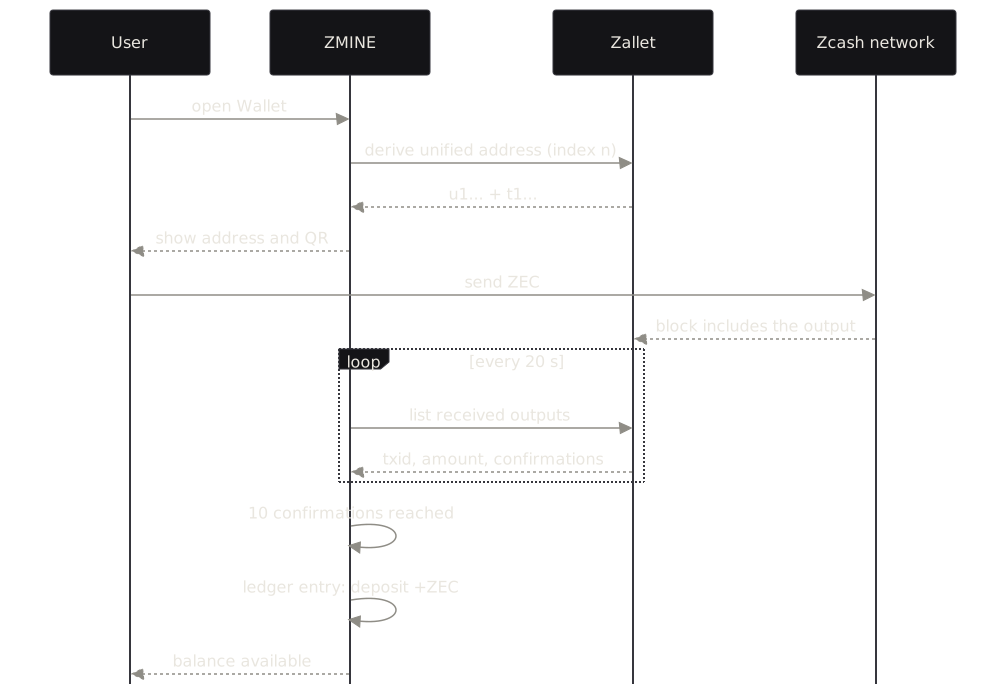
Your deposit address is created the first time you ask for it, on the Deposit tab, not when the account is made. Zcash lets a wallet hold only a short run of unused addresses at a time, so handing one to every account would exhaust them on people who never deposit. Once created it is yours permanently: a unified address (Orchard and Sapling receivers, shielded) and a transparent address. Send ZEC to either. The worker scans the wallet every 20 seconds and credits a deposit after 10 confirmations, about 12 minutes. A deposit that lands on the transparent receiver is shielded by the wallet within a minute (the Wallet page shows it, with a Shield now button for the impatient). Credited deposits that the wallet later stops reporting, which only happens in a chain reorganisation, are marked orphaned and reversed.
Withdrawals
Withdrawals go to any valid Zcash address; saved addresses are an address book. Two-factor, when enabled, is asked every time. Amounts at or above the review threshold wait for an operator check before they are sent. Everything else is signed within a minute, and the page follows it in four steps: requested, signed and sent, on chain with the confirmation count, confirmed after 10 confirmations. A transaction the network never mines is refunded in full.

Bridge
The Bridge tab moves value between ZEC and BTC, ETH, SOL, USDC, USDT and other assets on their native chains. Bridging in gives you a deposit address on the source chain with a live quote; the ZEC arrives at your own deposit address and is credited like any deposit. Bridging out queues a normal ZEC withdrawal to the bridge and the destination chain receives the other asset. ZMINE never holds another chain's asset; the swap is executed by NEAR Intents, the same rail Zashi uses, and its fees are inside the quoted rate.
Staking
Staking marks ZEC as staked in the ledger and it mines around the clock at 100.00 H per ZEC from the next epoch. On chain, every staked ZEC is backed one-to-one by the staking reserve: a separate wallet account whose transparent address is shown on the Wallet page, so anyone can verify on a block explorer that the reserve holds at least the total staked. The worker tops the reserve up from the hot wallet in batches and releases the excess back as stakes are withdrawn; no transaction happens per user, so staking costs nothing and is instant.
Unstaking starts a 24-hour cooldown. The ZEC stops earning at once, can be cancelled back into staking during the cooldown, and becomes available (and withdrawable) when it ends. Nothing ever leaves custody for staking; the only transfers are between the two accounts of the custody wallet.
Market
A price-time priority limit order book for MINE/ZEC.
The market is a central limit order book inside the same ledger as mining. Orders are limit only, matched by price then time, and fills settle atomically: MINE and ZEC move in one transaction. Prices are in ZEC per MINE with 8 decimals; the minimum order is 1 MINE.

- Taker fee
- 0.2% of what you receive
- Maker fee
- 0
- Self-trade
- prevented
- Candles
- 5 m, 15 m, 1 h, 4 h, 1 d
The SI advisor uses the last traded price to express pack returns in ZEC. Before the first trade there is no price, and the advisor says so instead of guessing.
SI layer
What to do next, auto-pilot, and earning hashpower with tasks.
The SI page is three tools on the same rig data. None of them can move funds outside limits you set, and none of them needs a model to run: the numbers are deterministic, and an optional written summary can be generated on request.

What to do next
For every possible action the advisor computes the marginal MINE per day: the daily rate after the action, with the network enlarged by the same hashpower, minus the rate now. Paid actions also get a return: extra MINE at the last price divided by cost. The list is sorted by priority, free actions before paid ones, then by gain.
Auto-pilot
Switch it on and set a daily ZEC limit. Every minute it can renew your session before it ends, buy a pack when the return clears your floor and no pack is running, and place a limit buy for MINE on a schedule. Spending features need a two-factor code to enable. Every action is logged and goes through the same code a tap would.
X tasks
Link your X account once and three tasks appear: follow, repost and quote. Each pays 10.00 H of free hashpower for 7 days, once per account. Linking works by posting a short code from the handle you claim, which is the only way to prove it is yours; after that every task is checked against X itself, so a screenshot proves nothing. The account must be at least 30 days old with 10 followers, and one X account belongs to one miner forever. Likes are deliberately not asked for, because X publishes no way to verify them.
Earn with tasks
Short verification questions with one defensible answer. A correct answer adds 5.00 H for 24 hours, up to 12 a day. Answers faster than 1.5 seconds do not count; 3 wrong in a row pauses you for 10 minutes. Credits are capped so the most a free account can add this way is 60.00 H, less than one staked ZEC.
Security and custody
What is protected, how, and the honest list of limits.
Custody model
ZEC you deposit is held by the ZMINE custody wallet, a light client built on the same wallet core as Zashi. It keeps its keys on a private volume, syncs compact blocks from public lightwalletd servers, which see which blocks we fetch and what we broadcast but never keys or balances, and is reachable only on the platform's private network. Deposit addresses are derived from the hot account; withdrawals are sent from it; transparent deposits are shielded into the Ironwood pool automatically. Staked ZEC is moved to a second account, the staking reserve, whose transparent address is public. The wallet seed and its encryption identity are backed up offline by the operators.
The ledger
Every amount is an integer of base units. Each balance has three buckets, available, locked and staked, and an append-only journal. A nightly audit checks that every balance equals the sum of its journal, that MINE adds up to exactly 210.00M, and that ZEC held equals deposits minus withdrawals. Money moves only inside database transactions with row locks; state transitions are conditional updates, so two workers can never pay the same epoch twice.
Accounts
- Login key
- 150 bits of entropy, stored as a hash
- Recovery phrase
- 24 words, stored as a hash
- Sessions
- server-side, HttpOnly Secure cookie, per-device revocation
- Two-factor
- TOTP, required for withdrawals, address changes, key rotation, auto-pilot spending
- Rate limits
- per account and per IP, shared across instances
Web
- Transport
- HTTPS with HSTS
- Content Security Policy
- per-request nonce, strict-dynamic, no third-party scripts
- Cross-site requests
- origin check on every mutation
- Headers
- no framing, no MIME sniffing, strict referrer
Withdrawals
Any valid address, two-factor on every request when enabled, operator review above a threshold, a pause switch for emergencies, on-chain progress shown to the user, and a full audit log.
Limits, stated plainly
The wallet is a hot wallet; the float kept in it is bounded and the rest is swept to cold storage on a schedule. The bridge depends on a third-party swap network and its quotes move with the market. MINE is a ledger token until it issues as a Zcash Shielded Asset after NU7, at which point ledger balances redeem 1:1. Rewards depend on participation and are never guaranteed.
FAQ
Short answers to the questions that come up.
Is mining really free?
Yes. A session costs nothing and earns a share of the 1,000 H free pool. Streaks, referrals and tasks add to it, also free.
Can I lose staked ZEC?
Staking never leaves custody or takes risk; it is a ledger bucket. The only way to lose it is to lose your account keys.
What is MINE worth?
Whatever the order book says. Before the first trade the app shows a reference price, labelled as such, for orientation only; nothing in the app trades or plans on it.
Can I bring funds from another chain?
Yes. The Bridge tab in the wallet takes BTC, ETH, SOL, USDC, USDT and more and delivers ZEC to your deposit address; the same tab sends ZEC out to those chains.
What is a Genesis Pass?
A numbered, limited mint: 3,000 passes, $2 of ZEC each, 30.00 H of permanent hashpower per pass. Mint as many as you like while they last.
Why 10 confirmations?
Zcash blocks are about 75 seconds apart; ten of them make a reorganisation of your deposit extremely unlikely. Withdrawals carry the same protection on the receiving side.
What happens at NU7?
MINE issues as a Zcash Shielded Asset with the same fixed cap. Ledger balances redeem 1:1 into shielded notes you control.
I lost my login key
Use the 24-word phrase on the recovery page. It reissues a login key and signs out every device. If both are gone, the account is gone.